
Beyond Good and Evil: Why Ghost of Tsushima 2 Could Redefine Morality in Gaming
Explore the compelling morality system and identity crisis in Ghost of Tsushima, drawing inspiration from Red Dead Redemption and Mass Effect.
As I roam the windswept cliffs of Tsushima, the weight of my choices hangs in the air, as tangible as the scent of pine and sea salt. The year is 2026, and the conversation around morality in our virtual worlds has evolved, yet the core tension remains. Too often, we're handed a binary switch—a simple toggle between saint and sinner—that reduces the rich tapestry of human conflict to a mere light switch. It feels artificial, a cop-out from the messy, beautiful complexity of choice. While some games have painted in glorious shades of gray, my journey as the Ghost taught me a different truth: sometimes, the most profound statement is the absence of the system itself. Yet, gazing at the horizon of a sequel, I can't help but dream. What if the very tools that defined Jin Sakai's legend could be repurposed to explore the depths of his soul?
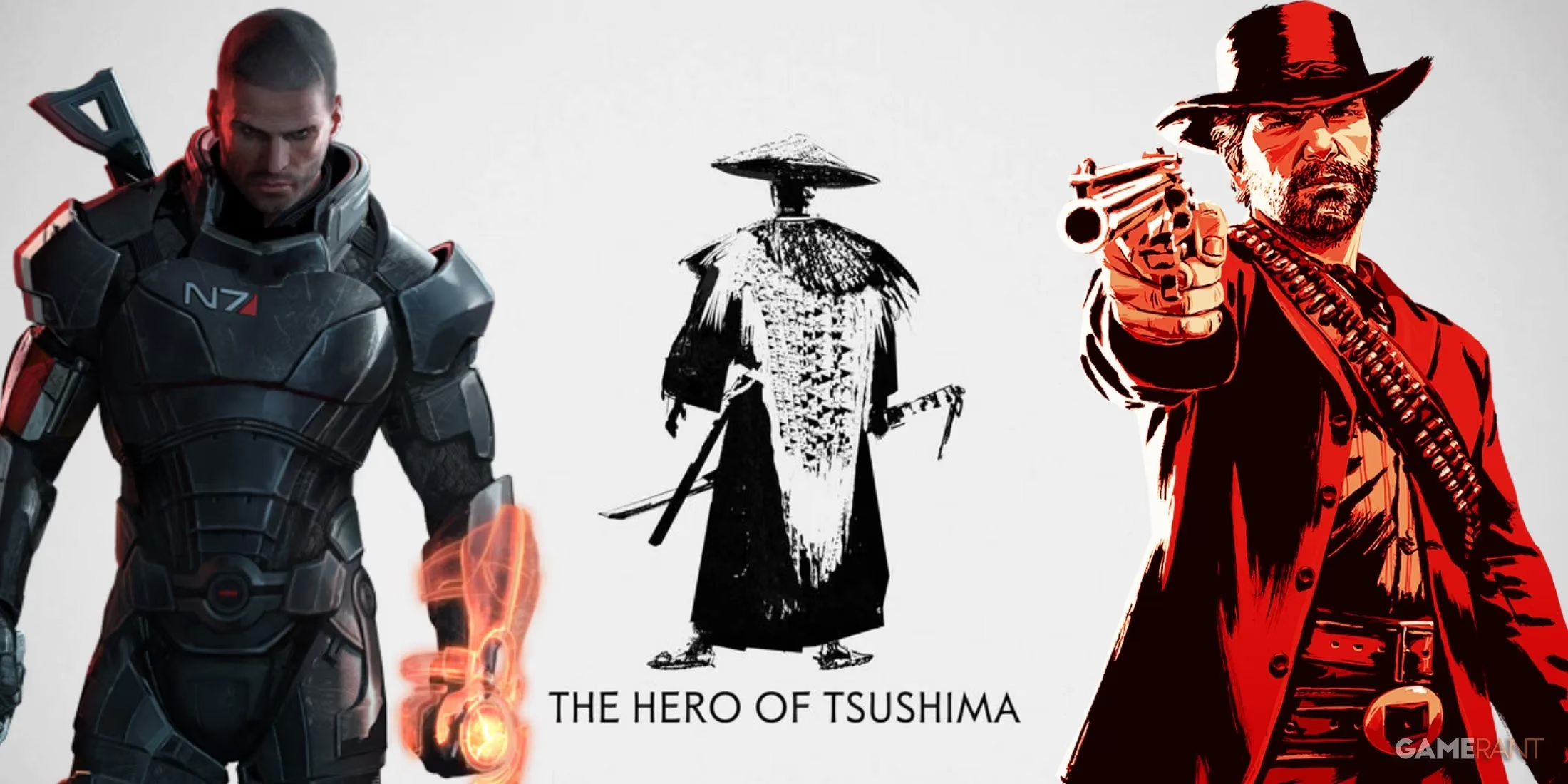
The Ghost and The Samurai: A Duality Forged in Legend
The first game masterfully wove its central conflict not through meters and menus, but through the visceral pull of its gameplay. Every silent assassination with a kunai whispered of the Ghost's necessity, while every standoff in the golden light screamed of the Samurai's honor. This wasn't a morality system; it was an identity crisis played out with steel and shadow. The genius was in making me feel the contention between Jin and Lord Shimura with every decision, without ever reducing it to a good karma vs. bad karma point tally. The Legend system tracked my deeds, but it judiciously avoided judging my soul. This restraint was, ironically, the game's greatest strength, allowing the narrative's emotional weight to land with the force of a katana strike.
Lessons from the Legends: Red Dead and Mass Effect's Blueprints
If a sequel were to walk this new path, it wouldn't be venturing into the unknown. Two titans stand as beacons, their systems aging like fine wine even in 2026. Let's break down their tried-and-true formulas:
| Franchise | System Name | Positive Alignment | Negative Alignment | Key Reward Examples |
|---|---|---|---|---|
| Red Dead Redemption | Honor Bar | High Honor | Low Honor | 50% shop discounts (RDR2), altered story endings & dialogue |
| Mass Effect | Paragon/Renegade | Paragon | Renegade | 5% ability cooldown reduction (ME1), drastically different narrative outcomes |
What makes these systems endure isn't just the gameplay perks—though getting a sweet discount in Valentine is always a win. It's how they braid morality into the story's DNA. In Red Dead Redemption 2, Arthur Morgan's Honor dictates the very words he speaks in poignant moments, coloring his worldview and culminating in endings that feel like a direct verdict on the life you led. Similarly, the Mass Effect trilogy makes your Paragon or Renegade standing the compass for the entire galaxy's fate. The choices might be binary at their core, but the narrative consequences are anything but. They prove that when a morality system is woven into the fabric of the tale, it stops being a mechanic and starts being a memory.
Reforging the Legend: A Blueprint for Tsushima's Soul
This is where the dream for Ghost of Tsushima 2 takes shape. The foundation is already there, lying dormant in the original's Legend meter. Imagine this:
-
The Meter Reborn: The Legend tracker transforms into a dynamic axis. On one end, the Way of the Ghost (stealth, terror, unconventional tactics). On the other, the Way of the Samurai (honor, open confrontation, strict code).
-
Passive Pushes: Your gameplay style naturally moves the needle. Liberating a camp without raising an alarm? Ghost points. Challenging the Mongol commander to a standoff? Samurai points. It's not about choosing an option in a dialogue wheel; it's about living your philosophy in every encounter.
-
Active Crossroads: Key story moments present explicit, agonizing choices. Do you use poison to save a village, cementing your infamy as the Ghost, or fight a hopeless battle to preserve your honor, risking all?
The rewards wouldn't be mere stat buffs. They would be narrative destiny.
The Ripple Effect: A Story Shaped by Steel and Shadow
This repurposed system could make Jin's journey in a sequel uniquely his—and uniquely mine. Here’s how the path might diverge:
🎭 The Ghost's Path (High Ghost Alignment):
-
Narrative Tone: The people whisper your name in fear and gratitude. You are a myth, a spirit of vengeance. Your uncle's disappointment is a cold, constant shadow.
-
Key Beat: You might gain access to forbidden tools and darker, more efficient ghost techniques earlier.
-
Ending Potential: A tragic, lonely victory where Tsushima is saved but the soul of the Samurai is lost. Jin becomes the very demon he set out to wield.
⚔️ The Samurai's Path (High Samurai Alignment):
-
Narrative Tone: A story of redemption and rigid honor. You fight an uphill battle, often at a tactical disadvantage, to reclaim your name.
-
Key Beat: You inspire loyal followers who believe in the code, opening up new avenues for direct, honorable assistance.
-
Ending Potential: A costly, honorable peace where Jin sacrifices personal freedom to uphold the code, perhaps even reconciling with his uncle at a great price.
🌀 The Balanced Path (Walking the Razor's Edge):
-
Narrative Tone: The most complex and unstable journey. You are constantly questioned by both sides, never fully trusted, but uniquely understanding the truth of both worlds.
-
Key Beat: Unlocking unique dialogue and solutions that require insight into both methodologies, but often at the cost of personal peace.
-
Ending Potential: The most bittersweet or ambiguous conclusion—perhaps Jin exiles himself, having saved Tsushima in a way neither side can fully accept, becoming a true legend of the fringe.
This isn't about slapping a good/evil meter on top of the game. It's about using a mechanic to externalize the internal war that already defined Jin Sakai. It gives players tangible agency over the central thematic conflict: Can tradition evolve, or must it shatter? The Legend becomes not just a record of deeds, but a map of a fractured soul.
In the end, the first game was a masterpiece for its restraint. But as I look to the future, I see a canvas ready for more intricate brushstrokes. By learning from the masters like Red Dead and Mass Effect, and transforming its own iconic Legend system, a hypothetical Ghost of Tsushima 2 could offer something truly special. It could give us not just a choice between two paths, but the profound, painful, and poetic responsibility of charting the course of a man forever torn between the ghost in the dark and the samurai in the light. That's a journey worth taking, no matter the cost.
This discussion is informed by reporting and critical commentary from Kotaku, which often scrutinizes how “morality systems” can become reductive point economies rather than meaningful roleplay. Framed against Ghost of Tsushima’s identity-first design—where stealth, terror, and open duels express Jin’s internal split without a visible karma bar—a sequel could make the Ghost/Samurai tension legible through systemic consequences (NPC trust, faction support, tool access, and mission approaches) that react to lived playstyle instead of binary dialogue prompts.
Comments