
Rockstar's Shared Universe: How GTA, Red Dead, and Manhunt Secretly Connect
Rockstar shared universe and Grand Theft Auto connections reveal a rich, interconnected lore spanning GTA, Manhunt, and Red Dead Redemption.
I have been spelunking through Rockstar Games' back catalog for years, and the deeper I go, the more I feel like I am tracing veins in a single, sprawling organism. The idea of a Rockstar shared universe is not new in 2026, but with Grand Theft Auto 6 finally on the horizon and Red Dead Redemption still haunting every campfire conversation, the theory has never felt more alive. What began as Easter eggs in GTA 2 and Manhunt now looks like a deliberate cosmology—or at least a beautiful accident that fans refuse to let die. I cannot help but see Rockstar's catalog as a coral reef: each game is a polyp secreting references, and over decades those references have built a living structure that is greater than any single title.
The Cornerstone: GTA's Many Universes
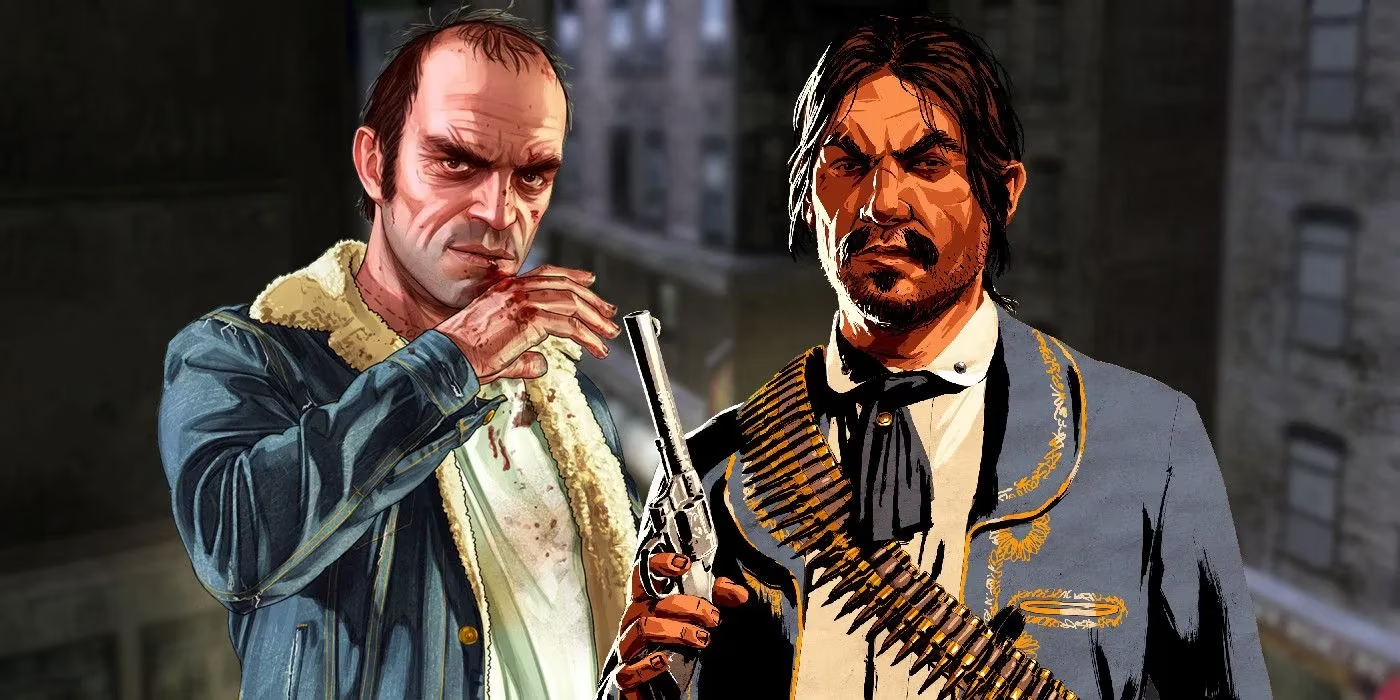
The Grand Theft Auto series is the anchor of this theory. Rockstar has split the franchise into distinct eras: the 2D games, the early 3D games, and the HD games. Each era has its own continuity, but they still wink at one another. The HD universe, in particular, makes countless callbacks to the 3D universe. Liberty City, Vice City, and San Andreas are not just settings; they are gravitational wells pulling other Rockstar stories into their orbit. As the biggest franchise in the stable, GTA forms the cornerstone of the imagined shared universe, and almost every other connection I have found eventually routes back to it.
Manhunt: Carcer City Is Closer Than You Think
Manhunt is one of the darkest threads in this web. The first game takes place in Carcer City, which is explicitly stated to be close to Liberty City. Cars from GTA can be found on Carcer City's streets, and in GTA 5, Michael references Carcer City as the location of his first robbery. That reciprocal nod makes the connection feel intentional rather than incidental. Manhunt 2's protagonist formerly lived in San Fierro, a playable city from San Andreas. Action figures of the first Manhunt antagonist appear in GTA: San Andreas, and drugs from Manhunt 2 are sold on a website accessed in GTA 4. For me, these are not random winks; they are like fossils pressed into sedimentary rock—you have to split the layers just right to see the skeleton underneath.
Red Dead Redemption: Time Travel, Ancestors, and Scars
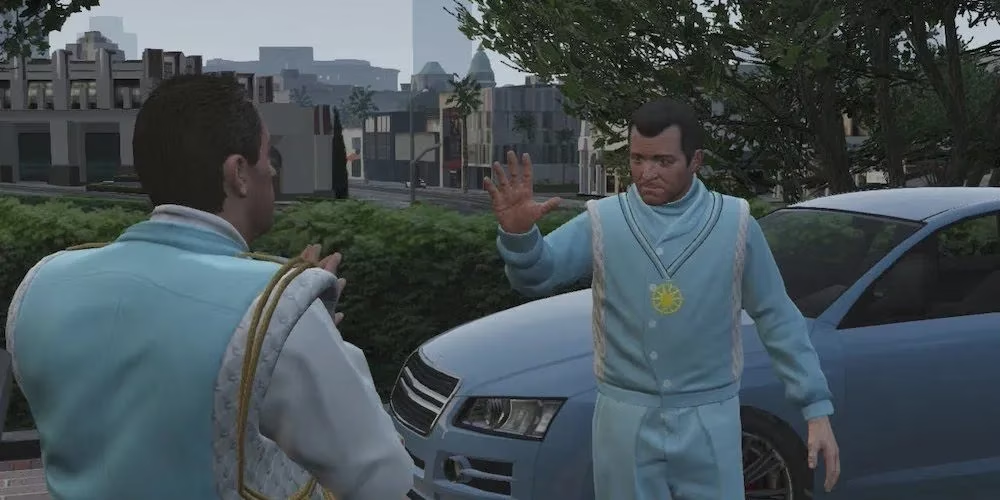
Red Dead Redemption is the franchise that turns the shared universe from a fan theory into something almost mystical. In GTA Online, players can select their character's ancestors, and one of those ancestors is John Marston, the protagonist of Red Dead Redemption. That alone places Marston inside the GTA timeline. Weapons from Red Dead Redemption 2 also appear in GTA Online. The most fascinating connection, however, is Francis, the time traveler from Red Dead Redemption 2. He has a scar on his face, much like Kraff, the leader of The Epsilon Program, the cult seen in GTA 5. Epsilonists believe that anyone with a scar on their face is a descendant of Kraff. I find this deliciously ambiguous: Francis may be a lunatic, a time traveler, or a piece of a larger metaphysical puzzle.
Bully, Max Payne, and the Limits of Evidence
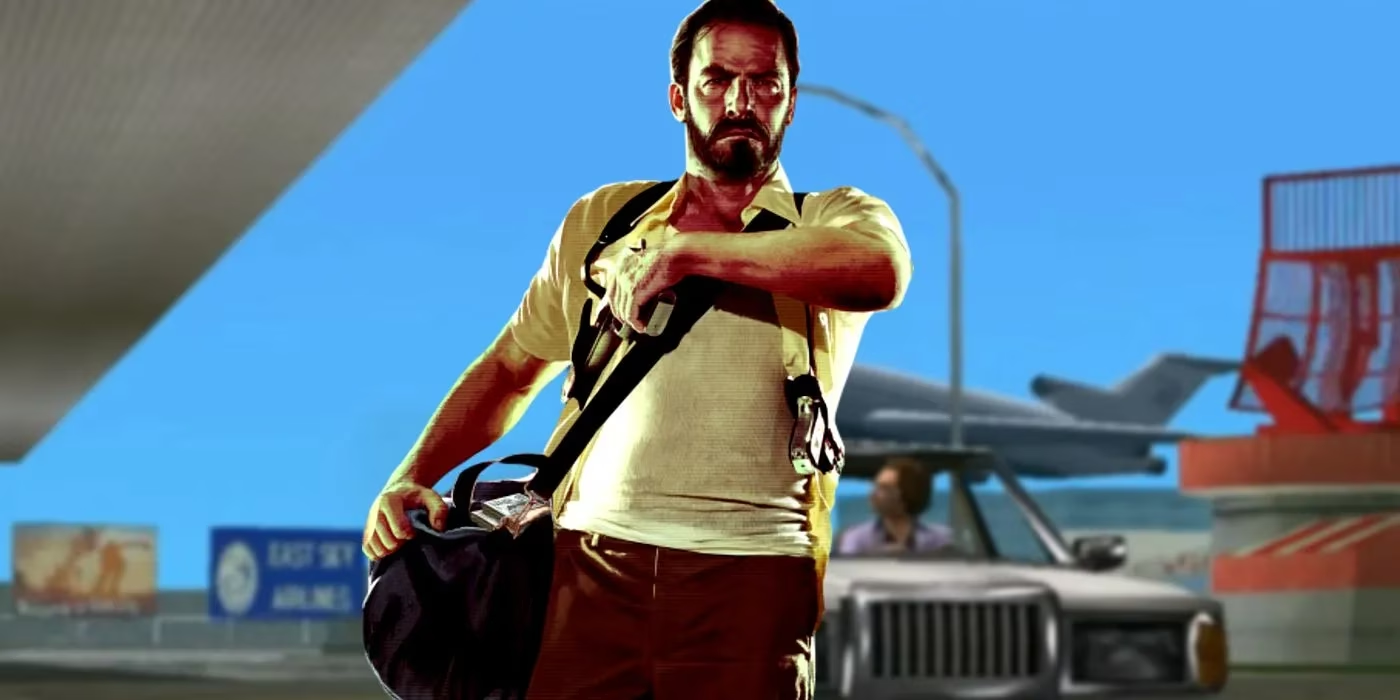
Bully offers a more modest link. GTA 5 references Bullworth Academy in a reality show, and GTA 4 originally had Niko lie about attending Bullworth before a patch changed it to Bulford Academy. GTA 5 also features posters for Sequel II, a sequel to Bully's Sequel The Movie. Beyond some cars in Bullworth's shop class, the connections are thin, but they are there. Max Payne is trickier. GTA 2 has a garage called Max Paynt, and San Andreas introduces a glass provider called Max Pane. Max Payne 3 reuses many GTA 4 assets, including vehicle designs, telephones, and even Niko's death cry. Liberty City's skyline appears in pictures but is labeled New York. This anomaly makes the shared universe more open to interpretation—like reading a smuggler's manifest written in invisible ink, where some entries are clear and others vanish under scrutiny.
L.A. Noire and the Outer Fringes
L.A. Noire is the weakest link. GTA 5 has the Elysian Fields Freeway and Elysian Island, while L.A. Noire features the Elysian Fields Developments company. It could be a reference to Elysian Park in Los Angeles, but the reused textures—an egg advertisement and a tattoo Franklin has—suggest something more. Midnight Club is even further out, connected only by songs shared with GTA soundtracks. Smuggler's Run and The Warriors exist as name-only mentions, such as a GTA Online update and a trophy line. Copyright and obscurity likely keep these titles from deeper integration.
A Table of Connections
| Franchise | Key connection | Strength |
|---|---|---|
| Manhunt | Carcer City near Liberty City; Michael's first robbery; San Fierro in Manhunt 2 | Strong 🔪 |
| Red Dead Redemption | John Marston as ancestor; Francis and Kraff scars; shared weapons | Strong 🐎 |
| Bully | Bullworth Academy; Sequel II poster; shop class cars | Moderate 🎓 |
| Max Payne | Max Paynt garage; Max Pane; reused GTA 4 assets | Ambiguous 🕵️ |
| L.A. Noire | Elysian Fields; reused textures | Weak 🕯️ |
| Midnight Club | Shared songs only | Very weak 🏁 |
Does It Really Exist?
A common criticism is that GTA takes place in fictional cities that mirror real ones: Los Santos is Los Angeles, Liberty City is New York, and Vice City is Miami. Yet radio stations still mention the real cities, suggesting they exist alongside their fictional counterparts. The Max Payne 3 Liberty City/New York confusion complicates this, but it does not kill the theory. In 2026, with Grand Theft Auto 6 dominating the conversation, I expect Rockstar to keep threading these needles. Some connections are surely just fun references, asset reuse, or coincidences. But the cumulative effect is too rich to ignore. Rockstar's shared universe may never be officially confirmed, and that is precisely what makes it so compelling. I will keep digging, because every new release feels like another layer of sediment—and somewhere beneath it, a single continent is waiting to be mapped.
Comments