
Why Red Dead Redemption 3 Must Keep Trains on Track and in Player Hands
The highly anticipated Red Dead Redemption 3 must innovate its Wild West legacy, with the iconic train feature being a critical gameplay element. This article passionately argues that removing the ability to drive trains would be a catastrophic step backward for the series. It demands that Rockstar Games not only retain this beloved feature but dramatically expand its narrative and strategic integration.
The ghost of Arthur Morgan and the legacy of the Van der Linde gang cast a long, dusty shadow over the future of the Wild West in gaming. As of 2026, the gaming landscape has been irrevocably shaped by the cinematic mastery of Red Dead Redemption 2 and the ever-evolving, chaotic playground of Grand Theft Auto Online. The pressure cooker is now firmly sealed for Red Dead Redemption 3, a title that exists more in the realm of feverish fan dreams than official announcement, yet already bears the colossal weight of expectation. It must innovate without stumbling, honor its roots without feeling stale, and clear a bar set dizzyingly high by its own predecessor and Rockstar's other titanic successes. One seemingly small, yet symbolically massive, feature sits at the heart of this challenge: the humble, chugging, iron horse—the train.
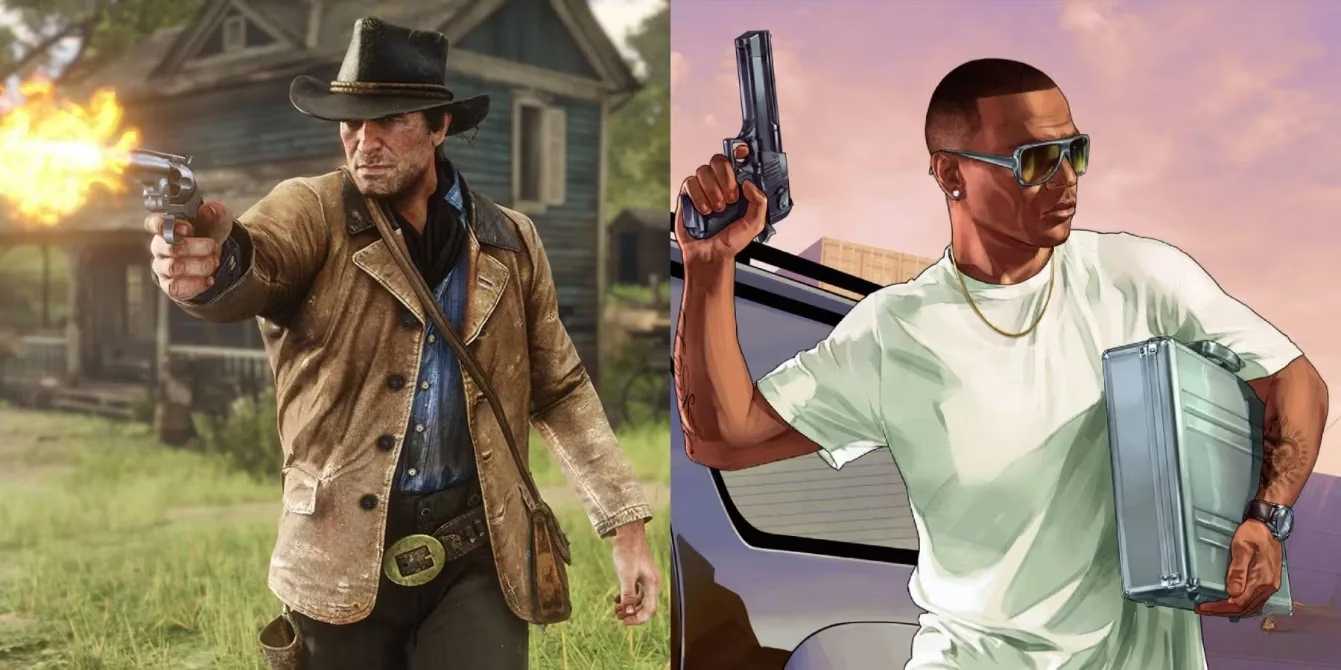
Let's be real: the train in Red Dead Redemption 2 wasn't just set dressing. It was a character. A lumbering, smoke-belching bastion of civilization cutting through the untamed wilderness. Robbing it was a rite of passage. But Rockstar, in their infinite wisdom, went a step beyond mere banditry. They handed players the keys—or rather, the throttle. The moment Arthur Morgan clambered into that locomotive cab and seized control was a quiet revolution. Sure, you couldn't take it off-roading (a severe design flaw, obviously), but you could make it crawl, race, or sit stubbornly on the tracks, a metal god deciding the schedule of the frontier. Compared to the reliable but predictable horse, commandeering a train was a glorious, absurd, and wonderfully pointless change of pace. It was the video game equivalent of buying a historic mansion just to use the fancy, ancient elevator.
The precedent has been set, and the gamers have spoken. In the years since RDR2, the ability to pilot large, unwieldy vehicles has only become more entrenched in the Rockstar ethos. Grand Theft Auto Online eventually caved and let players live out their chaotic train conductor fantasies in Los Santos. So, imagine the uproar, the sheer betrayal, if the protagonist of Red Dead Redemption 3—whether they're a new outlaw or a familiar face from the past—strolled up to a train and found the cabin door welded shut. It would be a step backward in a series known for monumental leaps forward. There's simply no logical, gameplay, or fun-based reason to remove this now-iconic slice of interactive whimsy. The community would notice. Oh, they would notice. Forums would burn. Tweets would be angsty. It would be a whole thing.
But keeping the feature isn't enough. Red Dead Redemption 3 needs to build on it. Integrate it. Make it sing. The train shouldn't just be a toy; it should be a tool, a stage, and a strategic element.
Consider the possibilities:
-
Narrative Integration: An early mission could involve not just robbing a train, but being forced to drive it as part of the getaway, navigating tense checks for lawmen or rival gangs while your crew defends the cars behind you.
-
Dynamic World Events: What if a random encounter involved a runaway train that the player must board and bring under control to prevent a catastrophic derailment in a nearby settlement? The moral choice—save the town or let it crash and loot the wreckage—writes itself.
-
Challenge System: "Drive the train from Valentine to Saint Denis without stopping and without hitting any livestock." Good luck with those cows, partner. 🐄🚂
The time period of RDR3 is a favorite topic of speculation. Whether it delves further into the heyday of the gunslingers or explores the dying gasps of the frontier, one historical constant remains: the railroad. It's the iron spine of the American West narrative. A story without trains would be like a cowboy without a hat—technically possible, but deeply, fundamentally wrong.
So, Rockstar, here's the memo from the peanut gallery in 2026: We expect the train heists. We demand the drama. But we also require that satisfying clunk of the throttle, the blast of the steam whistle, and the serene, powerful feeling of guiding several hundred tons of steel through your beautiful, deadly world. Don't just put the trains on the tracks. Put them in our hands, and then give us a reason to never let go. The legacy of the series, and the joy of countless potential joyrides, depends on it.
Comments